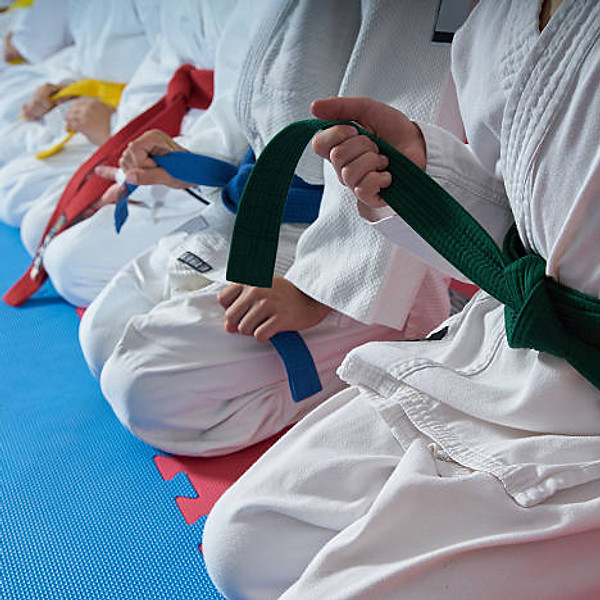
WMST Tae Kwon-Do are currently recruiting new members in your area who would like to come and try the exciting Korean Martial Art!
We have classes for everyone and currently have students of all ages (+5 years) and ability. We truly believe that Tae Kwon-Do and Martial Arts is for everyone and we will support you right from your very first class!
We are currently offering a 1 month FREE trial to all new students.
Upon gaining his Black Belt Mr Jones began to assist teaching at a number of WMST clubs, it became natural for him to progress into teaching. Mr Jones intends to continue to learn, enabling him to pass on his knowledge and experience to the highest possible standard, approaching his training with a traditional and respectful manner.
Mr Jones is a fully qualified and licenced Instructor with the British Tae Kwon-Do Council (BTC). He is fully DBS checked. Mr Jones has over 20 years competing experience and has won several prestige competitions including:
AIMAA Scottish Champion • PUMA English Champion • PUMA British Champion • VERVE Champions League Series
@TheEdge Community Centre, Typhoon Way, Brockworth, Gloucester, GL3 4DY
FAQ
Frequently Asked Questions
Everything you need to know before joining
Getting Started
Not at all! We welcome complete beginners of all ages from 5 years and up. Every single one of our current students started with no experience. You will be guided through everything from your very first session and progress at a pace that suits you.
We offer all new students their first full month of training completely free of charge with no obligation to continue. It's our way of letting you experience Tae Kwon-Do properly before committing. Just get in touch to book your first session.
For your first session just wear comfortable sports clothing — joggers and a t-shirt are ideal. You'll train barefoot so no specific footwear is needed. Once you decide to continue, we'll help you get your official dobok (Tae Kwon-Do uniform).
We have students from age 5 right through to adults. Classes are structured so that juniors and adults can train together whilst still working at an appropriate level. Tae Kwon-Do truly is for everyone regardless of age or fitness level.
Training & Grading
Tae Kwon-Do uses a coloured belt system to mark your progression. You begin as a white belt and work through yellow, green, blue and red before achieving Black Belt. Gradings are held periodically and your instructor will let you know when you're ready.
Classes are held at @TheEdge Community Centre, Typhoon Way, Brockworth, Gloucester, GL3 4DY. Please get in touch via the contact form or email coopersedge.taekwondo@yahoo.com for the current class schedule.
Yes. Safety is our top priority. Our head instructor Mr Adam Jones is fully DBS checked, a qualified First Aider, and a BTC registered coach. Classes are structured and supervised at all times, with technique and discipline emphasised over contact.
Membership & Costs
Please contact us directly for current membership and class fees. We aim to keep Tae Kwon-Do accessible and affordable for everyone. Get in touch via email or the contact form and we'll be happy to go through the options with you.
WMST is affiliated with the British Tae Kwon-Do Council (BTC). Membership of the BTC is part of joining our club and gives you access to official gradings, competitions, and insurance cover.
Members Area
Enter the club password to access training resources
Courtesy — To be polite to your instructors, seniors and fellow students.
Integrity — To be honest with oneself; to define right from wrong.
Perseverance — To not stop trying when pursuing a goal.
Indomitable Spirit — To show courage when pitted against overwhelming odds.
Self-Control — To live, work and train within your capability.
Key Dojang Rules
Always bow upon entering and leaving the dojang.
Address your instructor as Sir or Ma'am.
No jewellery to be worn whilst training.
Always keep your dobok laundered and ironed.
Free sparring only under black belt supervision.
Unruly behaviour will not be tolerated.
Never break trust.
Reference
Belt Meanings
Colour Meanings
White — Innocence; no previous knowledge.
Yellow — Earth; foundations being laid.
Green — Growth; skills begin to develop.
Blue — Heaven; maturing like a towering tree.
Red — Danger; exercise control, warn opponent.
Black — Maturity and proficiency; imperviousness to darkness and fear.
Time Between Gradings
10th Kup to 4th Kup — 3 months each grade
3rd Kup to 1st Dan — 6 months each grade
1st Dan to 2nd Dan — 2 years
2nd Dan to 3rd Dan — 3 years
3rd Dan to 4th Dan — 4 years
4th Dan to 5th Dan — 5 years
5th Dan to 6th Dan — 6 years, by invitation only
Reference
Oaths
International Tae Kwon-Do Oath
I shall observe the tenets of Tae Kwon-Do
I shall respect my instructor and seniors
I shall never misuse Tae Kwon-Do
I shall be a champion of freedom and justice
I shall build a more peaceful world
Tae Kwon-Do Oath
As a student of Tae Kwon-Do I do solemnly pledge to abide by the rules and regulations of the Tae Kwon-Do Association, to strive always to be modest, courteous and respectful to all members, in particular my seniors, to put the art into use only for self-defence of the weak and never to abuse my knowledge of the art.
Leg Raises Kick — 10 times on each leg (count aloud in Korean if possible)
Front Kicks — 10 times on each leg on kick shield
Sitting Stance Single Punch — 10 times (Ki-Hap on all punches)
Linework
Walking Stance, Middle Punch (obverse) — Ki-Hap on punches
Walking Stance, Middle Block (obverse)
Walking Stance, Middle Block followed by Reverse Punch
Performed forwards, backwards and on the turn. Examiner looks for: 50/50 weight distribution, bent front leg, straight back leg, stance 1 shoulder width wide and 2–3 shoulder widths long.
Set Sparring
Three-Step Sparring No. 1
Not Required at This Grade
Self-Defence — not applicable
Free Sparring — not applicable
Power Testing — not applicable
Sajo Jirugi (Four Directional Punch)
Number of Movements: 15 | Ready Position: Parallel ready stance
Meaning: Four directional punch. Sajo Jirugi is the first exercise given to all Tae Kwon-Do students to help develop coordination, direction change and breathing control. It is not a pattern.
Both Number 1 (low section blocks) and Number 2 (middle section blocks) are required. You will perform these as a group and on your own — do not copy others as they may make mistakes.
10th Kup Theory
Address all instructors and examiners as Sir or Ma'am.
Walking Stance, Middle Block followed by Reverse Punch
Walking Stance, Front Kick, Double Punch
L-Stance, Middle Block
Patterns
Sajo Jirugi — Numbers 1 & 2
Chon Ji (19 moves)
Set Sparring
Three-Step Sparring Nos. 1–2
Self-Defence
Single Wrist Grab — Left & Right hands with counter attack (Ki-Hap)
Chon Ji — 19 Moves
Ready Position: Parallel ready stance
Meaning: Chon Ji means literally "Heaven and Earth". In the Orient it is interpreted as the creation of the world or the beginning of human history. It is the first pattern learned by the beginner. The pattern consists of two similar parts — one representing Heaven, the other Earth.
Patterns should begin and end on the same spot. Correct posture and facing must be maintained at all times.
9th Kup Theory
Question
Answer
Meaning of Chon Ji
Heaven and Earth — creation of the world or beginning of human history. First pattern learned by the beginner.
Number of moves in Chon Ji
19
Meaning of Yellow Belt
Earth — foundations being laid
Instructor
Sabum
Student
Jeja
L-Stance (Back Stance)
Niunja Sogi
Walking Stance (Forward Stance)
Gunnan Sogi
Sitting Stance (Riding Stance)
Annun Sogi
High Section
Nopunde
Middle Section
Kaunde
Low Section
Najunde
Meaning of Tae Kwon-Do
The Foot and Hand way — Tae (kick/foot), Kwon (punch/fist), Do (art/method)
Any previous linework including Rising Block and Low Block/Rising Block combination
Basic kicks: front kick, side kick, turning kick
Patterns
Sajo Jirugi — Nos. 1 & 2
Chon Ji (19 moves)
Dan Gun (21 moves) — pattern for this grade
Set Sparring
Three-Step Sparring Nos. 1–3
Self-Defence
Release from Double Wrist Grab with counter attack (Ki-Hap)
Dan Gun — 21 Moves
Ready Position: Parallel ready stance
Meaning: Dan Gun is named after the holy Dan Gun, the legendary founder of Korea in the year 2333 BC.
Key points: introduces the high punch, knife-hand guarding block and twin forearm block. All high punches must reach high section. Rising blocks in sequence (moves 13–17) must be precise and rhythmic.
8th Kup Theory
Question
Answer
Meaning of Dan Gun
Named after the holy Dan Gun, legendary founder of Korea, 2333 BC
Number of moves in Dan Gun
21
Meaning of Green Belt
Growth — Tae Kwon-Do skills begin to develop
Rising Block
Chookyo Makgi
Guarding Block
Daebi Makgi
Twin Forearm Block
Sang Palmok Makgi
Obverse Punch
Baro Jirugi
Reverse Punch
Bandae Jirugi
Meaning of Courtesy
To be polite to one's instructor, seniors and fellow students
Self-Defence: Single Collar Grab with counter attacks
Do San — 24 Moves
Ready Position: Parallel ready stance
Meaning: Do San is the pseudonym of the patriot Ahn Chang-Ho (1876–1938). The 24 movements represent his entire life which he devoted to furthering the education of Korea and its independence movement.
Key points: introduces back fist strikes, fingertip thrust, and wedging block. Moves 15–16 and 19–20 are performed in fast motion. Moves 23–24 use sitting stance with knife-hand side strikes.
7th Kup Theory
Question
Answer
Meaning of Do San
Pseudonym of patriot Ahn Chang-Ho (1876–1938) who devoted his life to Korean education and independence
Number of moves in Do San
24
Meaning of Green Belt
Growth — Tae Kwon-Do skills begin to develop
Wedging Block
Hechyo Makgi
Vertical Fingertip Thrust
Son Sonkut Tulgi
Release from grab
Japiyo Soltay
High section Outer Forearm Block
Nopunde Bakat Palmok Makgi
Palm Pushing Block
Son Badak Makgi
Front Kick
Ap Chagi
Meaning of Integrity
To be honest with oneself; to define right from wrong
Power Testing: measure kicks, left and right turning kick and side kick
Self-Defence: Front and rear Bear Hug with counter attacks
One-Step Sparring Nos. 6–10
Right leg forward into left L-stance, right knife hand strike, left knife hand block, draw front leg back into vertical stance reverse knife hand strike
Left leg in-to-out crescent kick, high section right leg turning kick
45° out to the left, sitting stance, right hand outer forearm block, double punch, right leg mid section turning kick
Right leg forward into left L-stance, right hand inward hammer block, right hand back fist
Right leg forward into left L-stance, right hand inward hammer block, right elbow strike, spin 180° left elbow strike
Yul Gok — 38 Moves
Ready Position: Parallel Ready Stance
Meaning: Yul Gok is the pseudonym of the great philosopher and scholar Yi I (1536–1584) nicknamed the "Confucius of Korea". The 38 movements refer to his birthplace on 38° latitude and the diagram represents "scholar".
Key points: introduces the sitting stance double/triple punch combinations, hooking blocks, elbow strikes and the jump at move 36. Moves 2–3, 5–6, 9–10, 13–14 are performed in fast motion.
5th Kup Theory
Question
Answer
Meaning of Yul Gok
Pseudonym of philosopher Yi I (1536–1584), "Confucius of Korea". 38 moves = 38° latitude birthplace
Number of moves in Yul Gok
38
Meaning of Blue Belt
Heaven — the plant matures into a towering tree as training progresses
Hooking Block
Golcho Makgi
Back Fist Strike
Dung Joomuk Taerigi
Elbow Strike
Palkup Taerigi
Reverse Turning Kick
Bandae Dollyo Chagi
Hooking Kick
Golcho Chagi
Meaning of Self-Control
To live, work and train within one's capability; losing temper against an opponent can be dangerous
Linework includes jumping techniques (hand and foot)
One-Step Sparring Nos. 11–15
Free Sparring: 1–2 minute rounds
Power Testing: jumping kicks; Under 18s kick shield, Over 18s breaker boards
Self-Defence: Head Lock (Side) with counter attacks
One-Step Sparring Nos. 11–15
Right leg jump front kick off the spot
Left leg stepping across avoiding punch, right leg back kick
Right leg mid section front snap kick, 45° out to the right, sitting stance, left knife hand block, right reverse punch
Left leg walking stance, left hand rising block, grabbing arm walk through, right knife hand strike
Left leg walking stance, left knife hand block, right knife hand strike, right leg sweeping take down, punch
Joong Gun — 32 Moves
Ready Position: Closed Ready Stance B
Meaning: Joong Gun is named after the patriot Ahn Joong-Gun who assassinated Hiro-Bumi Ito, the first Japanese governor-general of Korea. The 32 movements represent Mr Ahn's age when he was executed in Lui-Shung prison (1910).
Key points: introduces the reverse knife-hand block, upward palm block, elbow strikes, X-fist rising block, U-shape block, and upset punch. Several moves are performed in slow motion.
4th Kup Theory
Question
Answer
Meaning of Joong Gun
Named after patriot Ahn Joong-Gun. 32 moves = his age at execution in Lui-Shung prison (1910)
Number of moves in Joong Gun
32
Meaning of Red Belt
Danger — caution to the student to exercise control; warning to the opponent
X-fist Rising Block
Kyocha Joomuk Chookyo Makgi
U-shape Block
Digutcha Makgi
Upper Elbow Strike
Wi Palkup Taerigi
Arc Hand Strike
Bandal Son Taerigi
Meaning of Indomitable Spirit
To show courage when you and your principles are pitted against overwhelming odds
Power Testing: jumping kicks; Under 18s kick shield, Over 18s breaker boards
Self-Defence: Hair Grab & Throat Grab (single and double with counters)
One-Step Sparring Nos. 16–20
Left leg walking stance, left palm pushing block, right elbow strike, right knife hand strike, grab, right leg sweeping take down, punch
Left leg walking stance, right hand hooking block, grab arm, high section hook kick right leg, low section hooking kick right leg, punch
Right leg jump turning kick off the spot
Left leg walking stance, right hand rising block, grab arm and twist to hold wrist, back leg front snap kick
Left leg stepping across avoiding punch, right leg reverse turning kick
Toi Gye — 37 Moves
Ready Position: Closed Ready Stance B
Meaning: Toi Gye is the pen name of the noted scholar Yi Hwang (16th century), an authority on neo-Confucianism. The 37 movements refer to his birthplace on 37° latitude and the diagram represents "scholar".
Key points: introduces W-shape block with stamping motion, pressing block with X-fist, twin side elbow thrust, knee strike, and a jump. Several moves performed in slow motion.
3rd Kup Theory
Question
Answer
Meaning of Toi Gye
Pen name of scholar Yi Hwang (16th century), authority on neo-Confucianism. 37 moves = 37° latitude birthplace
Number of moves in Toi Gye
37
Meaning of Red Belt
Danger — caution to the student to exercise control; warning to the opponent
Power Testing: jumping kicks; Under 18s kick shield, Over 18s breaker boards
Self-Defence: Joint Locks from all previous attack types; Knife Defence
One-Step Sparring Nos. 21–25
Right leg out-to-in crescent kick, mid section right leg side kick
Left leg out-to-in crescent kick, right leg jump spinning crescent kick
Right leg jump side kick off the spot
Left leg jump back kick off the spot
Right leg out-to-in crescent kick, place foot down, spin 360°, right leg jump turning kick
Hwa Rang — 29 Moves
Ready Position: Closed Ready Stance C
Meaning: Hwa Rang is named after the Hwa Rang youth group which originated in the Silla Dynasty in the early 7th century. The 29 movements refer to the 29th Infantry Division, where Tae Kwon-Do developed into maturity.
Key points: introduces high turning kicks in fast motion (moves 18–19), side elbow thrust, and pressing block with X-fist. The pattern includes a side piercing kick sequence and ends with knife-hand guarding blocks.
2nd Kup Theory
Question
Answer
Meaning of Hwa Rang
Named after the Hwa Rang youth group, Silla Dynasty, early 7th century. 29 moves = 29th Infantry Division
Number of moves in Hwa Rang
29
Meaning of Black Belt
Opposite to white — maturity and proficiency; imperviousness to darkness and fear
Introduction of TKD into the UK
By Master Rhee Ki Ha, 5th Dan, in 1967
The 3 Kingdoms of Korea
Koguryŏ, Baekje, Silla
Tae Kwon-Do Oath
I shall observe the tenets / respect the instructor and seniors / never misuse TKD / be a champion of freedom and justice / build a more peaceful world
Left leg forward into L-stance, left arm locking up punch, hold and spin 180°, right high section elbow strike
Drop down to left knee, right leg mid section side kick, right leg low section side kick to opponent's knee
Drop back on to hands, mid section front kick right leg, mid section front kick left leg in quick motion
Drop down to left knee, right leg low section turning kick, place right leg behind opponent's ankle, scissors action to take down, left leg axe kick to chest
Right leg jump twisting kick off the spot
1st Dan — Additional One-Step Nos. 31–35
Left leg forward into walking stance, left knife hand block, right mid section obverse punch, figure 4 arm lock, right leg step in sweeping take down, punch
Left leg forward into walking stance, left knife hand block, grab wrist, right knife hand strike, right hand scooping behind opponent's knee, pull wrist down as lifting knee, punch
Left leg out to sitting stance, arm break, holding arm rolling over elbow, left hand punch to temple
Left downward palm pushing block, spinning 360°, right knife hand strike
Side step left, chambering right leg, side kick, jumping forward into X-stance, right back fist strike
Patterns Required by Grade
Grade
Patterns
1st Kup → 1st Dan
Toi Gye (37), Hwa Rang (29), Choong Moo (30), Kwang Gae (39)
1st Dan → 2nd Dan
Po Eun (36), Ge Beak (44)
2nd Dan → 3rd Dan
Eui Am (45), Choong Jang (52), Ko Dang (39)
Choong Moo — 30 Moves
Meaning: Choong Moo was the name given to the great Admiral Yi Soon-Sin of the Lee Dynasty, reputed to have invented the first armoured battleship (Kobukson) in 1592. The pattern ends with a left hand attack to symbolise his regrettable death, having no chance to show his unrestrained potentiality.
Kwang Gae — 39 Moves
Ready Position: Parallel Stance with Heaven Hand
Meaning: Named after the famous Kwang Gae To-Wang, 19th King of the Koguryo Dynasty, who regained all the lost territories including the greater part of Manchuria. The 39 movements refer to the first two figures of 391 AD, the year he came to the throne.
Black Belt Theory — Sample Questions
The Chief Examiner determines the exact questions. All previously learnt colour belt theory also applies.
All pattern meanings required for your grade
All belt colour meanings
Name 5 patterns containing a back fist
Name 3 types of fingertip thrust
Why do we do 3-step sparring?
Why do we learn pattern meanings?
Name 3 patterns where we do a bending stance
History of Tae Kwon-Do
What is the purpose of the jump in Toi Gye & Yul Gok?
Why do we perform slow motion moves?
What is the difference between one-step and three-step sparring?
Why do we do the power test?
What attributes would you look for in a student?
What is the difference between our Tae Kwon-Do style and WTF?
What is Neo-Confucianism?
Name all the stances you know in Korean
There are 5 Tenets — if you had to choose a 6th, what would it be?
How have you developed as a person since starting Tae Kwon-Do?
What benefits does Tae Kwon-Do have in everyday life?
What's the difference between a sport and a martial art?
What's the difference between a black belt and an instructor?